Chart of the week: Looking under Alberta’s inflation hood in July
The slow grind from 3% to 2% Energy prices have already done the heavy lifting bringing Canada’s inflation rate towards 3%, down from the peak of over 8% in June 2022. The next leg of the journey to target will be more challenging. Canada’s inflation rate rose to 3.3% last month after a one-month vacation in the Bank of Canada’s 1-3% inflation control range. The reason: energy prices. They are down from a year ago, but just not as much as they were in June. In economics jargon, the ‘base period’ effect is coming off. Other drivers? Mortgage costs (+30.6% y/y in July) added almost a full point to the inflation rate, and food price growth remains—despite some moderation—stubbornly high at 7.8%. The Bank of Canada will look past month-to-month swings and drill into trend or ‘core’ inflation measures. The good news: these measures are slowly trending lower, including a decline in two of the three core readings (y/y and 3-month moving average). The bad news: they are still well above 3%. The Bank has made clear its resolve to bring inflation back to target—hence the surprise interest rate increase in June. Another rate hike cannot be ruled out, and the hotter-than-expected July inflation report makes it a closer call. That said, we lean towards a September pause given some progress on core inflation and signs of cooling in the labour market and consumer spending. But the Bank will keep monetary policy restrictive as long as it takes to get to its target. According to its July projections, 2% inflation won’t happen until mid-2025.
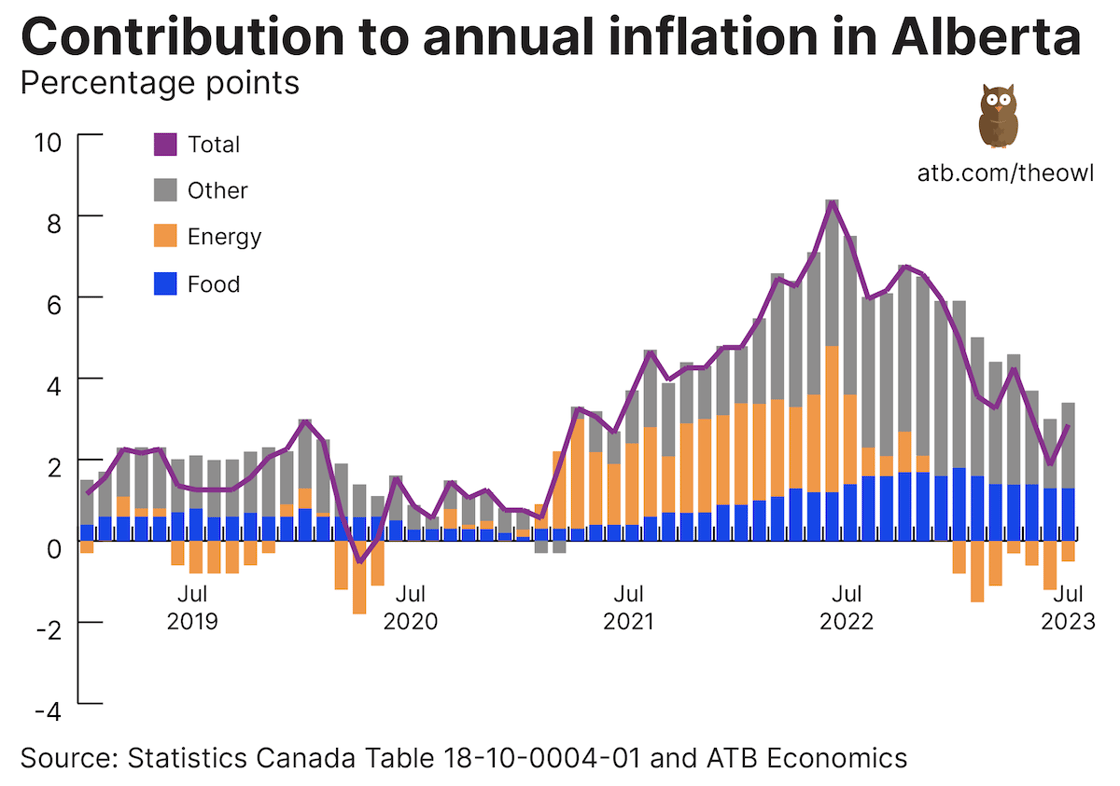
Alberta inflation jumped last month, but is still holding below the national rate.
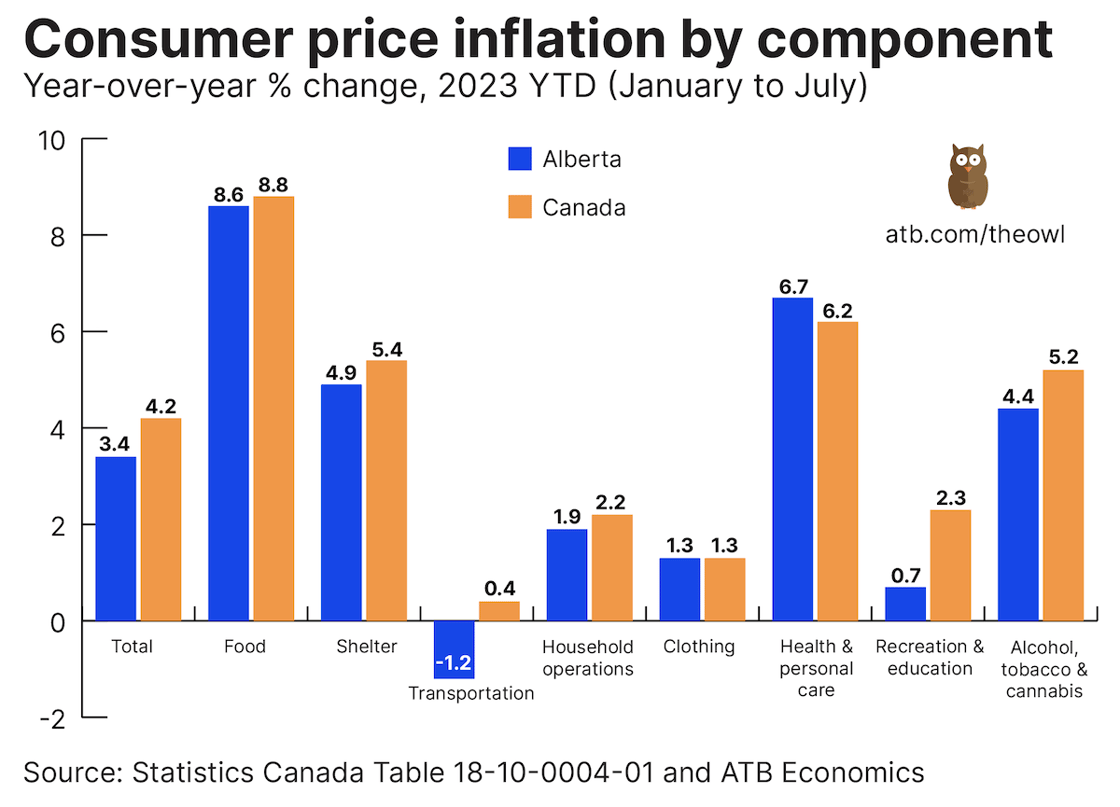
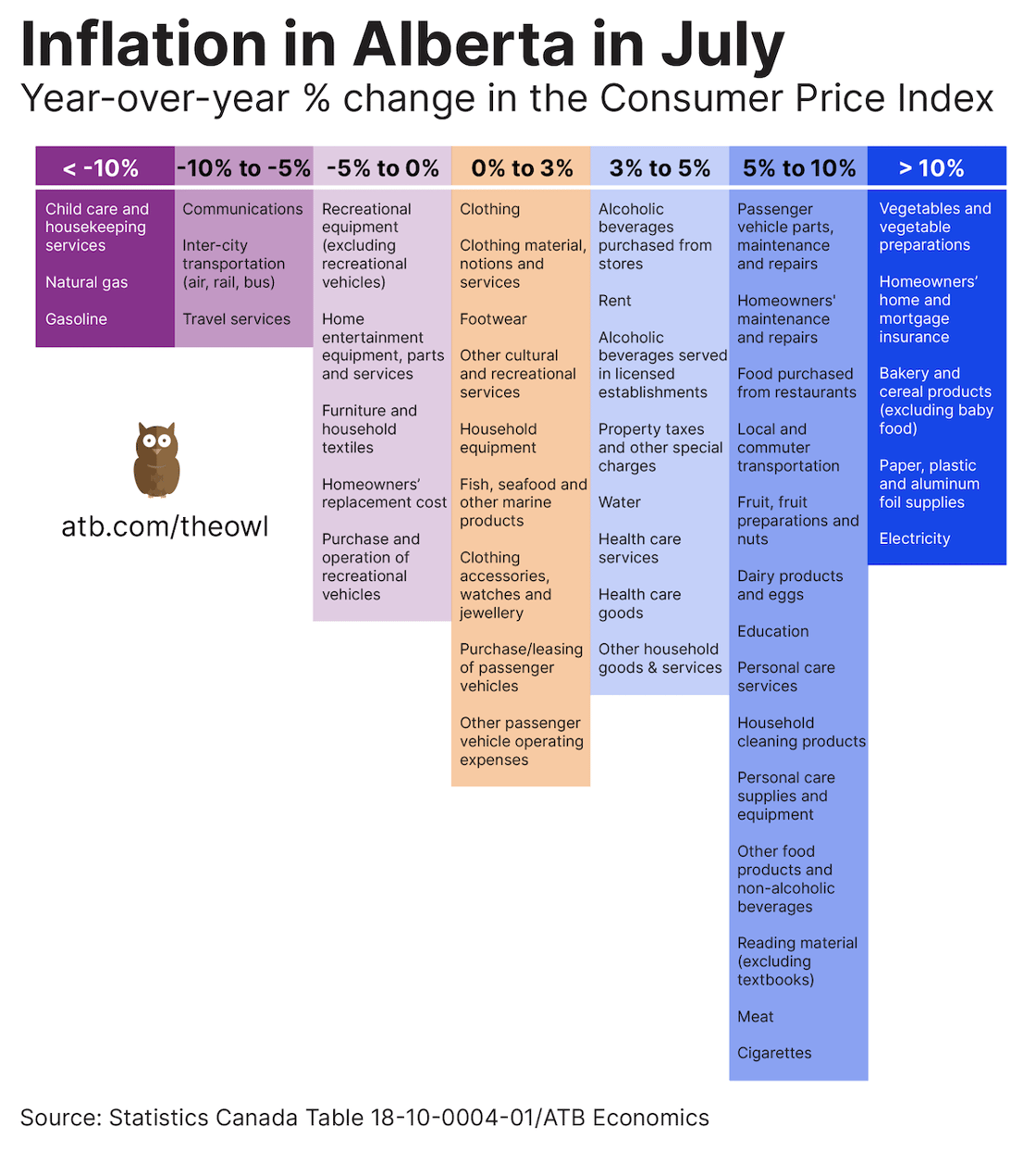
Alberta has spent the last 13 months below the national inflation rate. In July, the gap narrowed with the province’s inflation rate rising a full point to 2.9%. Electricity prices accounted for a large part of the increase—more than doubling from year-ago levels due to very high summer demand and the phasing out of some prior policy supports. This year Alberta has averaged 3.4% inflation, below 4.2% nationally (see chart). Transportation costs are down compared to a flat national reading, with the fuel tax pause (introduced in April 2022) contributing to larger annual declines in gasoline prices in early 2023. Lower food, recreation/education and shelter inflation also factor in. Alberta tends to track national inflation trends over longer periods, with shelter and energy costs mainly driving deviations. We expect Alberta to move more in line with the national average for the rest of the year. For more details on July’s inflation rate, see the Chart of the Week below.
Manufacturing sales pause following two year surge
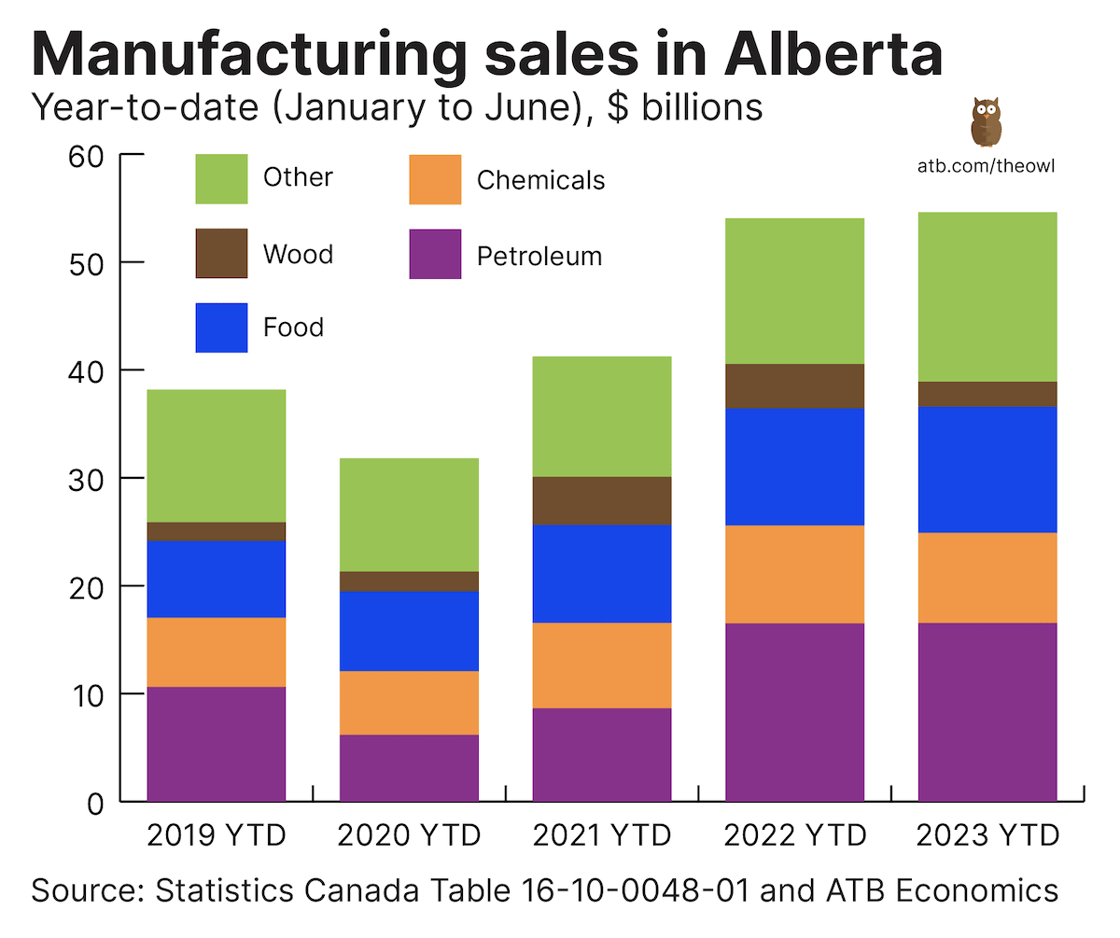
Shipment values in Alberta are leveling off after an impressive stretch. Alberta’s manufacturing sector has had a pretty good run, at least when it comes to the revenue side of the ledger. The value of shipments more than recovered in 2021 coming out of COVID and then kept climbing in 2022 as surging refined petroleum, chemical, wood, and food prices lifted sales. In the first half of 2023, progress stalled—revenue was up, but only slightly (1.1%).
Recall that shipments are heavily tied to the resource sector: the top product categories of refined petroleum, petrochemicals, food, and wood products accounted for about three-quarters of shipments last year. This makes them heavily sensitive to price swings. With prices down overall compared to the same time last year (particularly for refined petroleum and wood products), we are still shipping more volumes overall. We estimate volumes rose just over 3% in the first half, and expect manufacturing export volumes to rise 4% this year.
Alberta housing market heats up
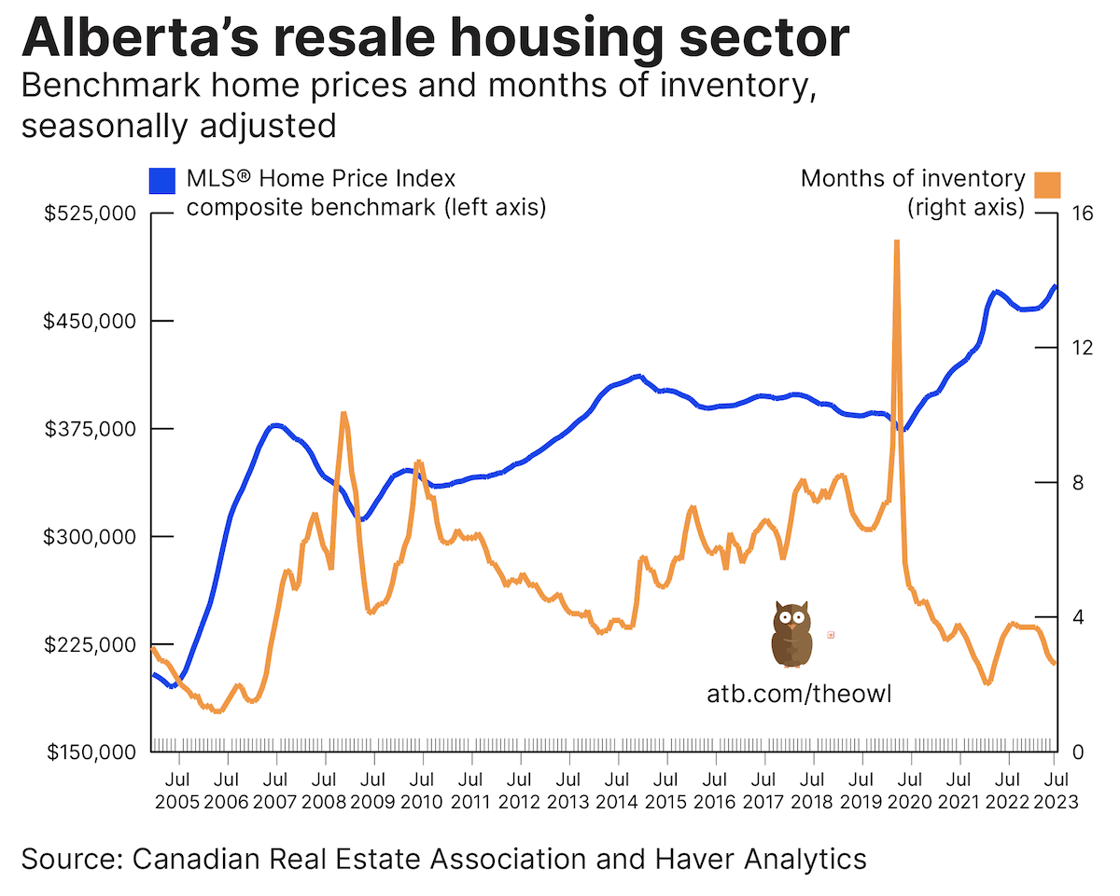
Soaring population growth has bumped up against a limited supply of homes, pushing prices and rents higher.
A dominant theme this year has been population growth, which is now running at a more than four decade high (4.5% y/y as of April). It is coming from all angles: international migration, inflows from other provinces and, as always, steady gains from natural increase (births minus deaths).
Last week, we reported that home construction has not kept pace with population growth. On that score, it was encouraging to see a jump in housing starts last month—38,500 annualized—the highest in 10 months—even as national starts edged lower. Still, starts remain below last year’s levels so far this year, weighed down by higher interest rates, construction costs, and a shortage of workers. New data on the resale market for July shows that conditions have tightened. Inventory of existing homes fell for the fifth straight month to 2.6 months of supply, with unit sales at a 14-month high. While new listings rose even faster, the sales-to-listing ratio remained firmly in seller’s territory at 73.9 (compared to 59.2 nationally). Despite sharply higher interest rates, benchmark Alberta prices rose again to a new high of $474,900, up 2.1% over the last 12 months and fueled by a 5.5% increase in Calgary. Rents in Alberta have risen faster, with a separate report showing that asking rents jumped 16% y/y in August. Even with these gains, both resale prices and rents remain much lower, on average, than in BC and Ontario—the origin of the vast majority of interprovincial inflows to Alberta in recent quarters.
Interesting fact… According to the latest report from CBRE, the office vacancy rate in Canada was 18.1% in the second quarter of 2023—the highest level since 1994. The suburban office vacancy rate was 17.1%. Only Calgary and Halifax saw their office vacancy rates fall in the second quarter, though Calgary continued to have the highest office vacancy rates among the 10 cities included in the CBRE report.
Chart of the Week (well, a table this week): Breaking down Alberta’s July inflation rate Every month, overall inflation numbers get reported with maybe a few details underneath. But the consumer price index is a collection of a wide range of items Albertans pay for every day. Statistics Canada surveys prices of a fixed basket of over 600 goods and services. Items are weighted by the share of household spending to create a composite index. For example, food prices are weighted about 17% in Alberta, and therefore have a larger impact on the overall inflation rate than the same change in many other components, like clothing and footwear at just over 5%. Below is Alberta’s July 2023 inflation rate of 2.9% broken down by different items, and organized (in ascending order for each bucket) by the amount the price rose or fell over the last 12 months.
Daily trivia Answer to the previous trivia question:The first warehouse bearing the name Costco opened in 1983. Today’s trivia question:Which Canadian economist was awarded the Nobel Prize in Economic Sciences in 1999?
This email was sent to rickp@mhaprairies.ca. If this email was forwarded to you, you can subscribe to ATB emails here.
You are subscribed to The Owl, ATB’s daily economic commentary.
We’d like to keep you up to date with products, services, special offers, news, advice or events we think you’ll find helpful. Choose the kinds of emails that you’ll receive by managing your preferences, or unsubscribe at any time if you no longer want to receive promotional emails from ATB. Learn more about CASL Preferences.
ATB Financial, 2100-10020, 100 St NW, Edmonton, Alberta T5J 0N3, Canada